 Technology
Introduction
Kenya has made remarkable progress in digitizing public services over the past decade. Platforms such as eCitizen, Huduma Centres, and online tax and business registration systems have demonstrated how technology can simplify interactions between citizens and government institutions. However, there is still significant opportunity to expand digital inclusion and ensure that every Kenyan—regardless of location, income, age, or disability—can access government services conveniently.
Technology should not replace human-centered service delivery; rather, it should enhance it. A balanced approach that combines digital platforms with physical service points can help create an efficient, inclusive, and transparent government.
The Current State of Digital Government in Kenya
Kenya's public sector has increasingly adopted electronic systems for identity management, business registration, tax administration, education services, healthcare information, and social protection programs. Many services that once required multiple office visits can now be initiated or completed online.
Despite these advancements, challenges remain, including:
- Limited internet connectivity in some rural and remote areas.
- Digital literacy gaps among sections of the population.
- System downtimes that affect service availability.
- Fragmented databases across government agencies.
- Cybersecurity risks and concerns over data privacy.
- Long queues during peak periods at physical service centers.
Addressing these challenges requires strategic investment and coordinated implementation.
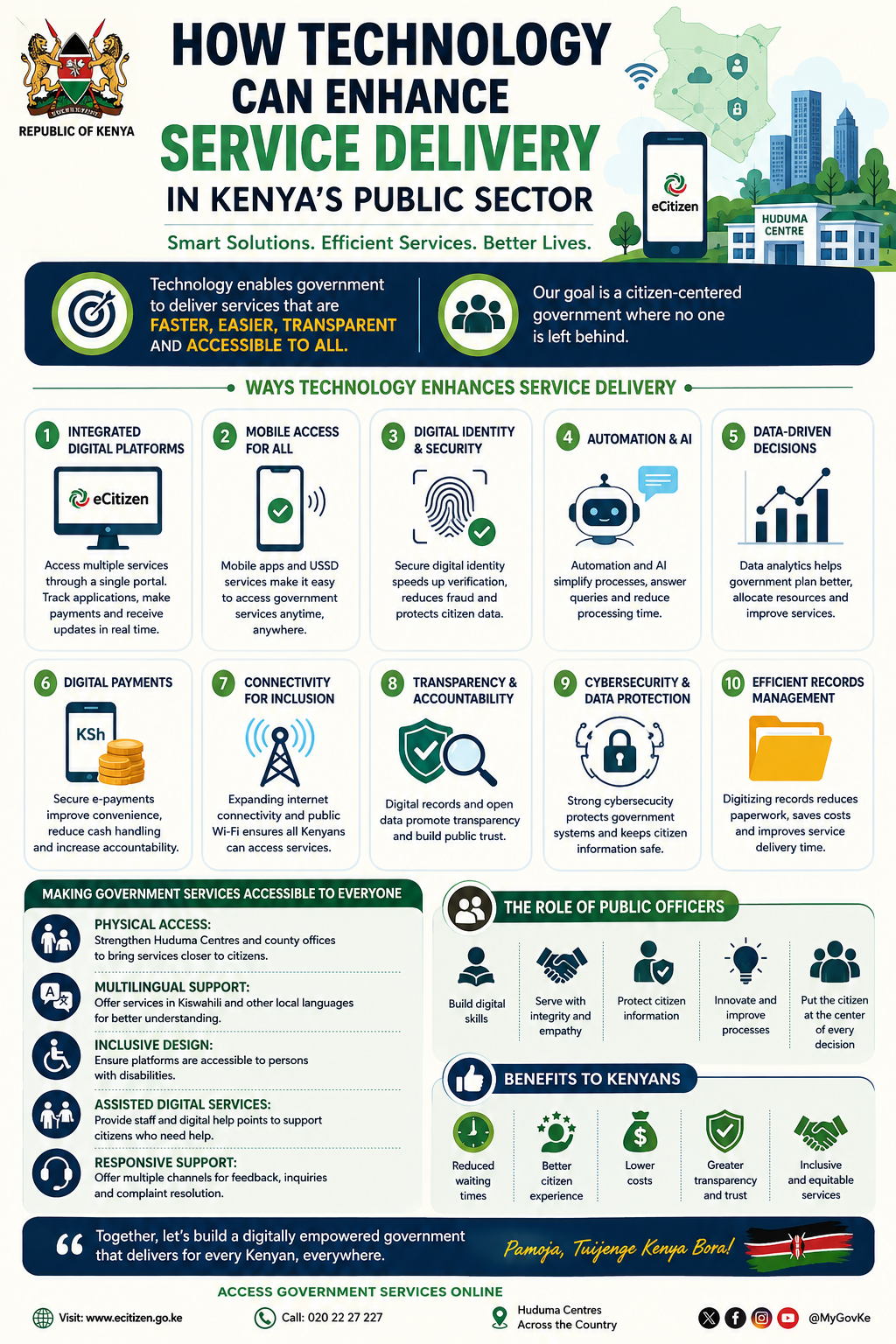
Ways Technology Can Improve Government Service Delivery
1. Develop Fully Integrated Government Platforms
Citizens should be able to access multiple government services through a single digital portal using one secure account. Instead of navigating separate systems for different ministries and agencies, integrated platforms can provide a unified experience.
Integration should allow:
- Application tracking in real time.
- Secure document sharing across agencies.
- Automatic verification of information.
- Single payment gateways.
- Digital notifications and reminders.
2. Expand Digital Services While Maintaining Physical Access
Although digital platforms increase convenience, not every citizen has access to smartphones or reliable internet. Kenya should continue strengthening Huduma Centres and county service centers while expanding assisted digital services.
Public officers can help citizens submit online applications, verify documents, and educate users on digital platforms, ensuring inclusivity for all.
3. Increase Mobile-Based Government Services
Given Kenya's high mobile phone penetration, many services should be optimized for mobile devices and accessible through lightweight applications or USSD solutions where appropriate.
Citizens should be able to:
- Track application status.
- Receive appointment reminders.
- Make secure payments.
- Obtain notifications.
- Access support without traveling long distances.
4. Strengthen Digital Identity and Authentication
Secure digital identity systems reduce fraud and speed up verification processes. Strong authentication mechanisms, including biometric verification and multi-factor authentication where appropriate, can help protect both citizens and government systems.
Reliable identity verification enables seamless access across multiple government services.
5. Improve Connectivity in Rural and Underserved Areas
Digital transformation cannot succeed without adequate infrastructure. Continued investment in broadband expansion, public internet access points, and reliable electricity can help bridge the digital divide and ensure equal access to services nationwide.
6. Digitize Records and Eliminate Paper-Based Processes
Electronic records management reduces document loss, speeds up retrieval, and improves operational efficiency. Ministries, departments, and agencies can benefit from secure digital archives that support faster decision-making and easier collaboration.
Digitization also reduces storage costs and supports environmental sustainability by minimizing paper usage.
7. Use Artificial Intelligence and Automation Responsibly
Artificial intelligence can assist with:
- Responding to frequently asked questions.
- Routing citizen inquiries.
- Processing repetitive administrative tasks.
- Identifying service bottlenecks.
- Supporting fraud detection.
These technologies should complement—not replace—human oversight, especially for decisions that significantly affect citizens.
8. Enhance Cybersecurity and Data Protection
As more services move online, protecting sensitive information becomes increasingly important. Government agencies should invest in:
- Secure authentication systems.
- Regular security audits.
- Encryption of sensitive data.
- Continuous staff training.
- Incident response planning.
- Public awareness on cyber hygiene.
Strong cybersecurity builds public confidence in digital services.
9. Promote Data Sharing Across Government Agencies
Citizens should not have to repeatedly provide the same information to different offices when it already exists within government systems and lawful sharing mechanisms are available.
Secure interoperability between agencies can reduce duplication, speed up service delivery, and improve accuracy while respecting privacy and applicable legal safeguards.
10. Expand Digital Payments
Secure electronic payment systems simplify fee collection, reduce cash handling risks, and improve accountability. Citizens benefit from faster transactions and immediate confirmations, while agencies gain better financial tracking and reporting.
Making Government Services Accessible to Everyone
To ensure that no Kenyan is left behind, accessibility should be a core principle of digital transformation.
Provide Multilingual Support
Government platforms should offer services in languages that improve comprehension and usability for diverse communities, helping more citizens understand procedures and requirements.
Design for Persons with Disabilities
Websites and mobile applications should include accessibility features such as screen reader compatibility, keyboard navigation, adjustable text sizes, and high-contrast display options to support users with different needs.
Simplify User Interfaces
Digital services should use plain language, intuitive navigation, and clear instructions to minimize confusion and reduce the need for in-person assistance.
Offer Assisted Digital Services
Trained personnel at Huduma Centres, county offices, libraries, and community digital hubs can assist citizens who need help completing online transactions.
Improve Customer Support
Dedicated help desks, call centers, chat services, and responsive complaint-resolution mechanisms can increase user satisfaction and ensure timely assistance.
The Role of Public Officers
Technology alone cannot transform service delivery. Public servants play a critical role by:
- Embracing continuous learning and digital skills development.
- Maintaining professionalism and integrity.
- Protecting citizen information.
- Responding promptly to public inquiries.
- Encouraging innovation and process improvement.
- Collaborating across departments to eliminate unnecessary bureaucracy.
A digitally empowered workforce is essential for sustainable modernization.
Benefits of a Technology-Driven Public Sector
When implemented effectively, technology can:
- Reduce waiting times.
- Improve transparency and accountability.
- Increase operational efficiency.
- Lower administrative costs.
- Expand access to services nationwide.
- Support evidence-based policymaking.
- Enhance citizen satisfaction and trust.
- Strengthen resilience during emergencies and disruptions.
Conclusion
Technology offers Kenya an opportunity to create a more inclusive, efficient, and citizen-centered public sector. By integrating digital platforms, strengthening infrastructure, protecting data, improving accessibility, and maintaining strong physical service channels, government institutions can ensure that services reach every citizen regardless of location or circumstance.
The future of public service delivery lies not only in adopting advanced technologies but also in designing systems that are simple, secure, and accessible to all. Through sustained investment, collaboration, and innovation, Kenya can continue building a government that delivers services efficiently while meeting the evolving needs of its people.






Leave a Comment