 Technology
Introduction
Networking has always been at the heart of modern information technology, enabling organizations to communicate, collaborate, and deliver digital services. Although the core principles of networking have remained consistent, the responsibilities of network engineers have expanded significantly over the last decade.
A CCNA-certified professional in 2015 primarily focused on configuring routers and switches, troubleshooting connectivity issues, and maintaining stable network operations. In 2026, those same responsibilities remain important, but they are complemented by automation, cloud integration, cybersecurity, and software-driven infrastructure.
What Defined a CCNA Engineer in 2015?
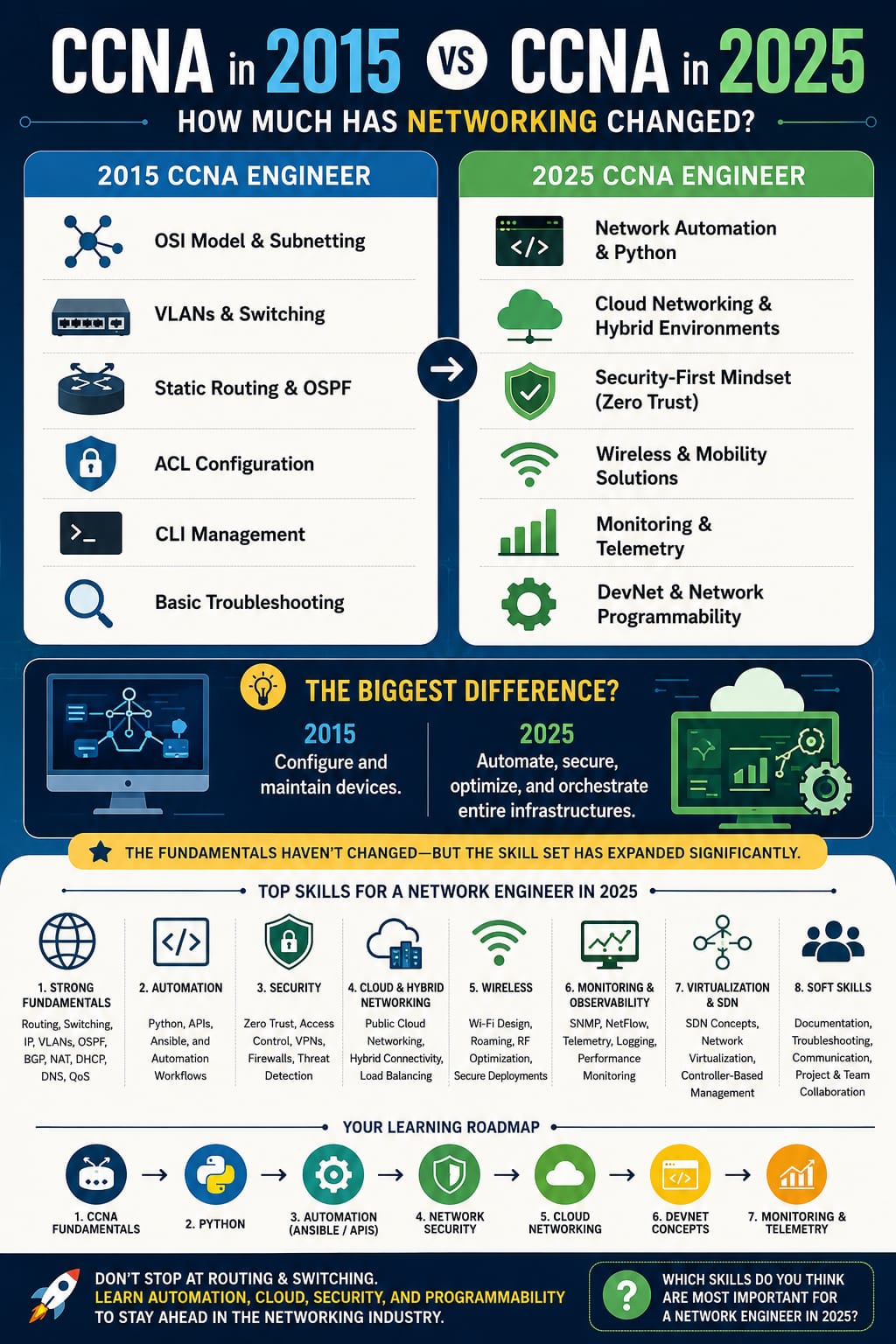
In 2015, enterprise networks were largely hardware-centric and manually managed. Success depended on understanding traditional networking concepts and configuring devices through the command-line interface.
Common skills included:
- Understanding the OSI and TCP/IP models
- IP addressing and subnetting
- VLAN configuration and inter-VLAN routing
- Static routing and dynamic protocols such as OSPF
- Access Control Lists (ACLs)
- Switch and router configuration using the CLI
- Basic troubleshooting and connectivity testing
These skills formed the backbone of enterprise networking and remain valuable today.
How the Role Has Changed by 2026
Digital transformation, cloud computing, remote work, and increasing cybersecurity threats have reshaped networking. Modern infrastructures are more dynamic and often span on-premises environments, public clouds, and hybrid deployments.
As a result, today's network engineers are expected to possess a broader and more versatile skill set.
Key competencies now include:
1. Network Automation
Manual configuration is increasingly supplemented by automation tools and scripting languages. Engineers use Python, APIs, and infrastructure-as-code techniques to deploy configurations consistently and reduce operational errors.
2. Cloud Networking
Organizations are integrating cloud services into their infrastructure, making knowledge of virtual networks, hybrid connectivity, and cloud-based networking services highly valuable.
3. Security-First Design
Cybersecurity is no longer a separate discipline. Network engineers play a central role in implementing secure architectures, segmentation, identity-aware access controls, and Zero Trust principles.
4. Wireless and Mobility
Modern workplaces depend on reliable wireless connectivity. Engineers must understand enterprise Wi-Fi design, roaming behavior, and secure wireless deployments.
5. Monitoring and Observability
Traditional monitoring has evolved into real-time visibility through telemetry, performance analytics, logging, and proactive alerting to identify issues before users are affected.
6. Network Programmability
Software-defined networking and programmable interfaces enable infrastructure to be managed through code, allowing faster deployments and greater scalability.
The Biggest Difference
The biggest shift between 2015 and 2026 is not the replacement of networking fundamentals but the expansion of responsibilities.
2015 Network Engineer:
- Configure and maintain networking devices.
- Perform manual troubleshooting.
- Focus primarily on hardware administration.
2026 Network Engineer:
- Automate repetitive tasks.
- Secure increasingly complex environments.
- Integrate cloud and on-premises networks.
- Monitor infrastructure proactively.
- Manage networks through APIs and software tools.
Skills That Matter Most in 2026
To remain competitive, aspiring network engineers should focus on developing expertise in:
- Routing and switching fundamentals
- IPv4 and IPv6 networking
- Python scripting
- Network automation platforms
- Cloud networking concepts
- Cybersecurity best practices
- Network programmability and APIs
- Monitoring and telemetry tools
- Wireless technologies
- Communication and documentation skills
Learning Roadmap
A practical progression for modern networking professionals is:
- Master CCNA fundamentals.
- Learn Python scripting.
- Explore automation tools and APIs.
- Develop strong network security knowledge.
- Study cloud networking concepts.
- Understand DevNet and programmability.
- Gain experience with monitoring and observability platforms.
Conclusion
Networking in 2026 is more dynamic than ever. The traditional skills taught through CCNA remain essential, but they are now only part of a much larger toolkit. Professionals who combine solid networking fundamentals with automation, cloud expertise, security awareness, and programmability will be better positioned to succeed in today's rapidly evolving IT landscape.
Rather than viewing these new technologies as replacements, successful network engineers embrace them as natural extensions of the core principles that have always powered reliable and resilient networks.








Leave a Comment