 Business Technology
Introduction
The business landscape has undergone a profound transformation over the past two decades. Organizations no longer compete solely on price, product quality, or geographic reach. Instead, they compete on their ability to leverage technology, harness data, innovate rapidly, and deliver exceptional customer experiences.
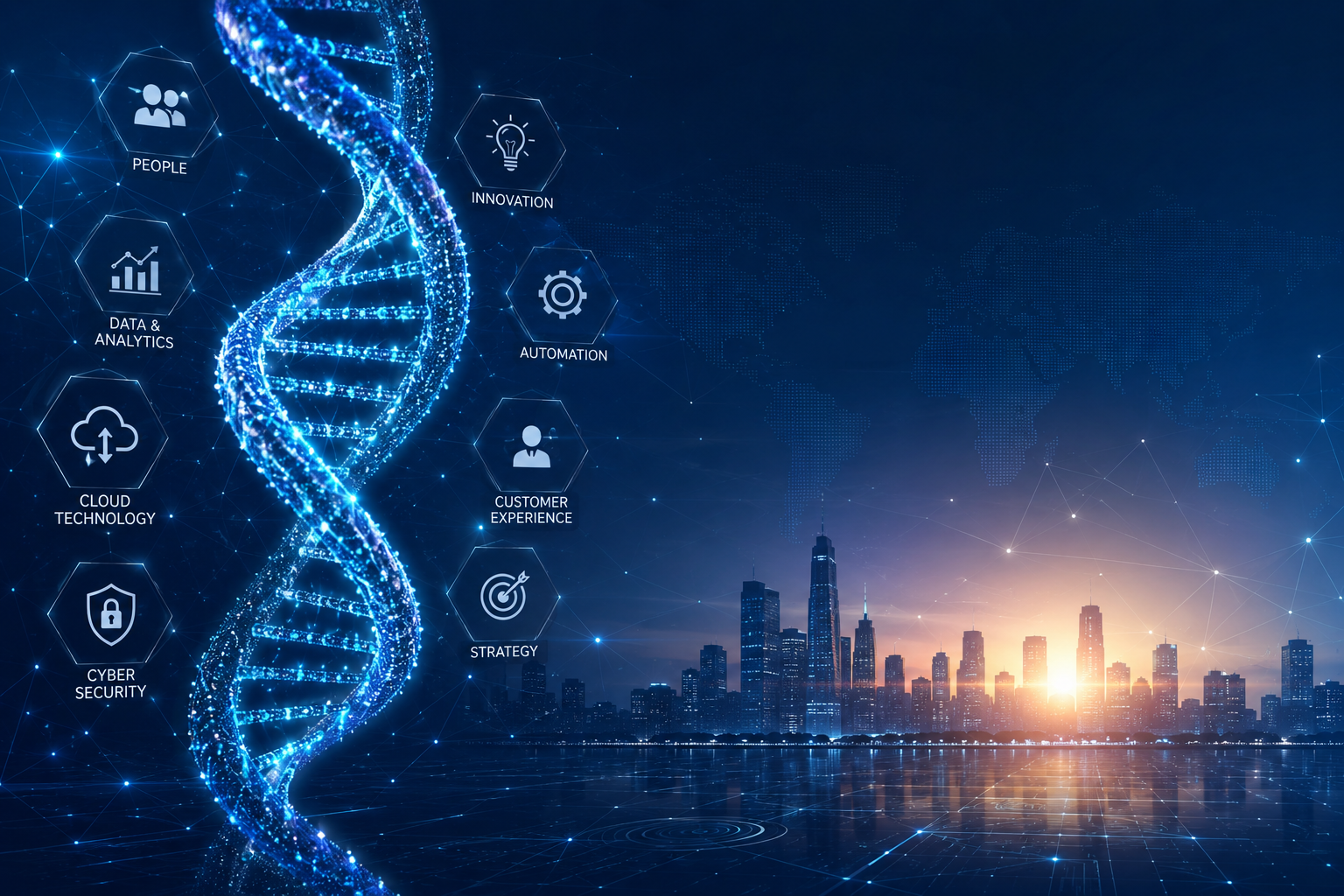
Just as biological DNA determines the characteristics and capabilities of living organisms, an organization's Digital DNA defines its ability to adapt, innovate, and thrive in the digital economy. Companies with strong Digital DNA consistently outperform competitors because they are built to respond quickly to market changes, customer expectations, and technological disruptions.
The question for modern organizations is no longer whether to embrace digital transformation but how to embed digital capabilities into their core identity.
Understanding Digital DNA
Digital DNA refers to the collection of values, capabilities, technologies, processes, and behaviors that enable an organization to operate effectively in a digital-first environment.
It is not a single technology platform or software application. Rather, it is the integration of:
- Digital culture
- Data-driven decision making
- Innovation mindset
- Agile operations
- Customer-centric design
- Technology adoption
- Continuous learning
- Strategic leadership
Organizations with strong Digital DNA view technology as a strategic enabler rather than merely an operational tool.
Why Competitive Advantage Has Changed
Traditional sources of competitive advantage are becoming increasingly temporary.
Historically, businesses relied on:
- Physical assets
- Market dominance
- Capital investment
- Proprietary infrastructure
- Geographic exclusivity
Today, digital technologies have lowered barriers to entry, allowing startups and smaller organizations to challenge established industry leaders.
Modern competitive advantage depends on:
| Traditional Advantage | Digital Advantage |
|---|---|
| Physical Assets | Data Assets |
| Scale | Agility |
| Products | Experiences |
| Hierarchies | Collaboration |
| Efficiency | Innovation |
| Ownership | Ecosystems |
Organizations that fail to evolve risk becoming irrelevant in rapidly changing markets.
The Core Components of Digital DNA
1. Digital Leadership
Transformation begins at the leadership level.
Digital leaders:
- Embrace innovation
- Encourage experimentation
- Support calculated risk-taking
- Invest in emerging technologies
- Promote cross-functional collaboration
Effective digital leaders understand that technology is a business strategy rather than an IT function.
Leadership Characteristics
- Visionary thinking
- Adaptability
- Data literacy
- Customer focus
- Change management expertise
2. Data as a Strategic Asset
Data has become one of the world's most valuable resources.
Organizations with strong Digital DNA treat data as a strategic asset that informs every decision.
Data-Driven Organizations
They use analytics to:
- Understand customer behavior
- Improve operational efficiency
- Predict market trends
- Manage risks
- Personalize services
Examples include:
- Predictive maintenance
- Fraud detection
- Customer segmentation
- Demand forecasting
The ability to transform raw data into actionable insights creates a significant competitive advantage.
3. Customer-Centric Innovation
Modern consumers expect:
- Convenience
- Personalization
- Speed
- Transparency
- Accessibility
Organizations with strong Digital DNA design services around customer needs rather than internal processes.
Customer-Centric Practices
- Human-centered design
- User experience optimization
- Omnichannel engagement
- Continuous customer feedback
- Service personalization
Customer expectations are evolving faster than ever, making innovation essential for survival.
4. Agile and Adaptive Operations
Digital organizations prioritize flexibility over rigidity.
Agility enables organizations to:
- Launch products faster
- Respond quickly to disruptions
- Adjust strategies in real time
- Reduce operational inefficiencies
Agile Principles
- Rapid iteration
- Continuous improvement
- Collaborative teams
- Faster decision-making
- Customer feedback integration
Organizations with adaptive operations can pivot quickly when market conditions change.
5. Innovation Culture
Technology alone cannot create competitive advantage without a culture that encourages innovation.
Innovative organizations:
- Reward creativity
- Encourage experimentation
- Learn from failures
- Invest in research and development
- Support continuous improvement
Innovation becomes a daily practice rather than an occasional project.
Characteristics of Innovative Cultures
- Curiosity
- Collaboration
- Learning mindset
- Openness to change
- Entrepreneurial thinking
6. Digital Skills and Talent
People remain the most critical component of Digital DNA.
Organizations must develop talent capable of operating in a technology-driven environment.
Key digital skills include:
- Data analytics
- Cybersecurity
- Cloud computing
- Artificial intelligence
- Software development
- Digital marketing
- User experience design
Continuous learning ensures employees remain relevant as technologies evolve.
7. Cybersecurity and Digital Trust
Trust has become a competitive differentiator.
Customers increasingly choose organizations that demonstrate strong:
- Data protection
- Privacy practices
- Cybersecurity measures
- Ethical technology use
Digital trust directly influences customer loyalty and brand reputation.
Building Digital Trust
- Secure systems
- Transparent policies
- Regulatory compliance
- Responsible AI practices
- Incident response readiness
Organizations that prioritize trust gain long-term competitive advantages.
Digital DNA Framework
The Competitive Advantage Model
DIGITAL LEADERSHIP ↓ DIGITAL CULTURE ↓ DATA + TECHNOLOGY ↓ INNOVATION ↓ CUSTOMER EXPERIENCE ↓ COMPETITIVE ADVANTAGE ↓ SUSTAINABLE GROWTH
Each layer strengthens the next, creating a cycle of continuous improvement and innovation.
The Role of Artificial Intelligence
Artificial Intelligence (AI) is becoming a critical element of Digital DNA.
Organizations use AI to:
- Automate repetitive tasks
- Enhance customer support
- Generate insights
- Improve decision making
- Optimize operations
AI-Driven Advantages
- Faster processes
- Better predictions
- Reduced costs
- Personalized experiences
- Enhanced productivity
The organizations that effectively integrate AI into their operations are likely to dominate future markets.
Digital DNA in the Public Sector
The concept of Digital DNA extends beyond private enterprises.
Governments can leverage Digital DNA to improve:
- Service delivery
- Citizen engagement
- Transparency
- Accountability
- Operational efficiency
In Kenya, initiatives such as:
- Digital identity systems
- E-government services
- Online licensing platforms
- Integrated payment systems
- Citizen service centers
demonstrate the growing importance of digital transformation in public service delivery.
A strong public-sector Digital DNA can significantly improve citizen trust and service accessibility.
Challenges to Building Digital DNA
Organizations often face barriers such as:
Resistance to Change
Employees may fear:
- Job displacement
- New technologies
- Process changes
Solution
Invest in change management and continuous communication.
Skills Gaps
Many organizations lack digital expertise.
Solution
Implement training programs and digital upskilling initiatives.
Legacy Systems
Outdated technologies hinder innovation.
Solution
Develop phased modernization strategies.
Cybersecurity Risks
Greater digitization increases exposure to threats.
Solution
Adopt security-by-design principles.
Building a Strong Digital DNA
Organizations should focus on the following actions:
1. Develop a Digital Vision
Create a clear roadmap aligned with business goals.
2. Invest in People
Prioritize skills development and digital literacy.
3. Modernize Infrastructure
Adopt cloud, automation, and scalable technologies.
4. Strengthen Data Governance
Ensure data quality, privacy, and accessibility.
5. Foster Innovation
Encourage experimentation and continuous improvement.
6. Enhance Customer Experience
Place customer needs at the center of every initiative.
7. Build Digital Trust
Invest in cybersecurity, transparency, and ethical technology practices.
The Future of Competitive Advantage
The future belongs to organizations that can continuously evolve.
Emerging technologies such as:
- Artificial Intelligence
- Internet of Things (IoT)
- Blockchain
- Quantum Computing
- Extended Reality (XR)
- Advanced Analytics
will further redefine competitive advantage.
Success will depend less on possessing technology and more on integrating it into an organization's Digital DNA.
Organizations that cultivate adaptability, innovation, and trust will remain resilient regardless of future disruptions.
Conclusion
The Digital DNA of Competitive Advantage is not built through technology investments alone. It emerges from the deliberate integration of leadership, culture, data, innovation, talent, and trust into every aspect of an organization.
In an era where disruption is constant and customer expectations continue to rise, organizations must evolve beyond traditional business models. Those that successfully embed digital capabilities into their organizational DNA will not only survive but thrive in the digital economy.
Competitive advantage is no longer determined by what an organization owns—it is determined by how effectively it learns, adapts, innovates, and creates value in a connected world.
The organizations that master their Digital DNA today will become the industry leaders of tomorrow.
1 Comments
Anonymous
Aug 01, 2026Nice content .






Leave a Comment